Festoons
Transcript
Thank you for allowing me to speak today on the treatment of festoons. This is a very challenging topic, and the anatomy is beyond us here, but suffice it to say for this lecture that they are bounded inferiorly by the zygomaticocutaneous ligament. And I wish we could achieve results like this every time.
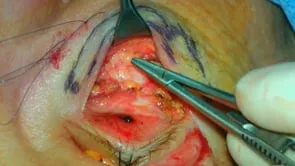
First, I would like to talk about camouflaging a festoon with fat repositioning. So I don't have to go through fat repositioning here because you know it well, but I'll give you a few pointers that I use. Here is some blunt dissection in order to expose the arcus marginalis. Then I make an incision about one to two millimeters inferior to the arcus through the periosteum with the monopolar cautery instrument. I actually use the cautery instrument in order to perform the subperiosteal dissection. It works very well, it's quite elegant, and it's a very quick way to undermine the periosteum here.
The most important point regarding fat repositioning for treatment of festoons is the depth of the pockets. You can see here that the pockets have to be extremely deep in order to recruit fat into the area surrounding the festoon. Here you can see the inferior oblique muscle. I do not dissect it out completely, and I form a T-shaped pedicle medially. This T-shaped pedicle allows the pedicle to be placed, and it will then spread both superiorly and inferiorly along the nasojugal groove, allowing for great augmentation in that area. Again, the idea here is to use the fat to basically raise the tide around the festoon.
Here you can see that T shape is starting to come into view. Here I'm going to do a little bit more dissection in order to really get that T shape so that it will spread into the superior and inferior areas. The idea is the pedicle really should be able to be displayed in this area without any tension at all because, as I'll show later, I don't use any suture fixation.
Then I do the same thing for the central pocket. I often form a T-shaped pedicle in this area too, which again allows for concealing the festoon. Very important: although I don't show it on this video because it was made for fat repositioning, I almost always use a lateral pedicle as well when using fat repositioning to camouflage a festoon. Here you can see that these T-shaped pedicles will mesh together very nicely to form a nice, smooth area all around the festoon, to raise the tide, thereby camouflaging the festoon. Here I drew in a little picture of the festoon to show how it will camouflage it.
So I don't use any suture fixation. I basically place the pedicles into those really deep pockets. So it's a really long pedicle and a deep pocket. Then I often use the backside of a 0.5 to basically pinch the fat pedicle under that trailing edge of periosteum. That allows for stable fixation of the pedicles without any sutures. Basically, the idea here is to camouflage the festoon with fat surrounding it. Here's a patient before and after fat repositioning, also with tetracycline, with a nice improvement.
Next, I'd like to talk about resuspending and effacing the festoon with a cheek lift and skin removal. The idea here is basically to lyse the zygomaticocutaneous ligament and remove some skin in order to elevate and diminish the compartment in which the festoon can exist.
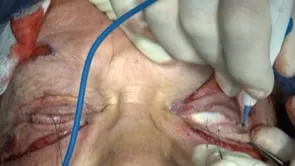
So I won't completely review subperiosteal cheek lifting here, but it begins with, and then the dissection continues under the tarsus. This can be extended all the way to the caruncle for cases where we also perform fat repositioning. This patient has had previous surgery elsewhere, so there's a bit of a scar here that we have to fight through in order to bluntly dissect towards the arcus marginalis. Then, similar to how we made an incision medially for fat repositioning, I'm going to do the same thing here, one to two millimeters outside of the arcus marginalis, through the periosteum with the monopolar cautery instrument.
Again, I also do the subperiosteal dissection here with the monopolar. This is awesome here because it will cauterize the zygomaticofacial and zygomaticotemporal foramina, which can leak a little bit. So this really speeds the dissection, and this can be done in literally a couple of minutes. The really important point here is to dissect all the way medially to the nerve, all the way laterally to the zygoma, and very far inferiorly, up to four centimeters or so beneath the rim, in order to lyse the zygomaticocutaneous ligament. You can see here how far the dissection needs to extend. With the dissection descending this far, we can get excellent elevation after releasing the periosteum inferiorly.
So here's another case, and on the other side, a little bit more robust SOOF here. Again, we make an incision through the SOOF and the periosteum towards the frontozygomatic suture. Then we dissect with the cautery instrument. Again, this allows for an elegant, very efficient dissection along the zygomaticocutaneous ligament, which we're going to lyse in this area here. It will allow for great hemostasis with the zygomaticofacial and zygomaticotemporal vessels. So again, the dissection has to proceed very far inferiorly. Then, once the dissection proceeds far enough inferiorly, I make an incision through the periosteum in order to completely free the cheek to allow for excellent mobilization of the festoon. The entire dissection can be performed in minutes, so it's a really quick dissection.
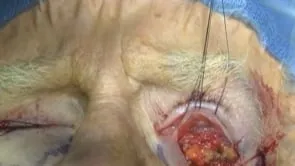
Then here I'm going to make an incision through the periosteum, and I apologize, it's a little hard to see. I used a case here of a larger festoon and more elderly patient in order to get a better view beneath this large flap. So I would typically use a right-angled retractor here, but this makes it a little easier to see. Again, the dissection has to proceed well underneath the festoon in order to lyse the zygomaticocutaneous ligament.
Here you can see the festoon, and watch what happens to the festoon when we grasp the SOOF and elevate it. You can see that we get a really nice elevation of the zygomaticocutaneous ligament. Again, you can see with a PDS suture how that is going to lift and then diminish the compartment in which the festoon can exist.
With skin removal, here I perform a skin pinch. For more aggressive cases, I'll do a larger skin flap. The combination of the elevation and skin removal basically decreases and effaces the compartment for the festoon. Here's a patient who underwent combined cheek lift with fat repositioning. You can see the wide dissection pocket that is created here. Here you can see, by elevating and effacing the festoon and shortening the eyelid, we can get a nice overall cosmetic improvement. In this case, cheek lifting to elevate the festoon, skin removal to efface it, and fat repositioning to camouflage it can also help.
Now, last, I would like to talk about sclerosing the festoon with tetracycline. I've talked about this before, with a couple of papers that we've published looking at tetracycline as a sclerosing agent. This can be performed either in the operating room or in the office. The idea is to inject the tetracycline throughout the festoon to basically create scar tissue beneath the festoon in order to seal the fluid blister. Our previously published papers have shown about a 50% success rate, so it's not perfect, but it does offer a relatively less invasive option.
When it's performed in the office, it is a bit uncomfortable. The other issue with tetracycline is that it requires in a compounding pharmacy, which is not ideal for most practitioners. Doxycycline can be used, but I do not have experience with that.
Here's a patient who underwent tetracycline injection on the right side, and you can see a nice improvement in the festoon with tetracycline alone. Here's a patient from Rob Tower that shows a dramatic improvement after tetracycline injection. Finally, we can combine these techniques to yield what I think are sometimes the best results. So here's a patient with fat repositioning, cheek lift, tetracycline, with ptosis repair. Here's another patient with fat repositioning and cheek lift. Finally, the patient that we saw before with cheek lifting, fat repositioning, and skin removal.
So, in summary, festoon treatment is very humbling, and I hope that this has given you some options that can match the patient's level of commitment, either something as simple as in-office tetracycline injection or more involved procedures in order to try and achieve better results to improve festoons. Thank you.